Artificial Photosynthesis


Nate Lewis, the George L. Argyros Professor of Chemistry at the California Institute of Technology, works to develop new technologies to meet the immense energy needs of the future in a sustainable way. Lewis specializes in what’s called artificial photosynthesis. In nature, photosynthesis is the process plants use to make food from the sun’s energy. Dr. Lewis works to mimic that process.
Nate Lewis spoke with EarthSky’s Beth Lebwohl.

Artificial Leaf


MIT Professor Dan Nocera believes he can solve the worlds energy problems with an Olympic-sized pool of water. Nocera and his research team have identified a simple technique for powering the Earth inexpensively by using the sun to split water and store energy - making the large-scale deployment of personalized solar energy possible.

New planet similar to Earth discovered: How far is 600 light years away?


Kepler-22b, the newly discovered planet that’s been proclaimed “eerily similar” to Earth, is sitting just outside our solar system, in the habitable zone of a sun-like star, some 600 light years away. The discovery has been called “thrilling,” and “a great gift ... like a Christmas planet.” But how close is the new Earth really? 
Since one light year is the equivalent nearly six trillion miles, it would take 22 million years to travel 600 light years on a space shuttle and visit Kepler 22-b with our current technology.The following diagram from NASA indicates just how far our closest near-“solar twin” really is:
But while we won’t be able to visit this Kepler-22b, scientists say another planet like it and closer to it could be discovered in this lifetime. The Kepler telescope has already detected hundreds of new planets, Washington Post.

Scientists Find Way to Identify Synthetic Biofuels in Atmosphere

Scientists at the University of Miami Rosenstiel School of Marine & Atmospheric Science have discovered a technique to track urban atmospheric plumes thanks to a unique isotopic signature found in vehicle emissions. Read more on Science Daily.

Nanoscale Secret to Stronger Alloys: Scientists Find Nanoparticle Size Is Readily Controlled to Make Stronger Aluminum Alloys

 
 Long before they knew they were doing it -- as long ago as the Wright Brother's first airplane engine -- metallurgists were incorporating nanoparticles in aluminum to make a strong, hard, heat-resistant alloy. The process is called solid-state precipitation, in which, after the melt has been quickly cooled, atoms of alloying metals migrate through a solid matrix and gather themselves in dispersed particles measured in billionths of a meter, only a few-score atoms wide. Read more on Science Daily.

Pioneers Get Close-Up View of Miracle Material Graphene


Physicists who won last year's Nobel Prize for isolating graphene, the world's thinnest material, said Sunday they had devised ways of studying the novel substance at the fundamental level of the electron. Read more on Discovery News.

Conformal Mapping

In mathematics, a conformal map is a function which preserves angles. In the most common cases the function is between domains in the complex plane.
f: U->V
is called conformal (or angle-preserving) at u0 if it preserves oriented angles between curves through u0 with respect to their orientation. Conformal maps preserve both angles and the shapes of infinitesimally small figures, but not necessarily their size.
The conformal property may be described in terms of the Jacobian derivative matrix of a coordinate transformation. If the Jacobian matrix of the transformation is everywhere a scalar times a rotation matrix, then the transformation is conformal.
Conformal maps can be defined between domains in higher dimensional Euclidean spaces, and more generally on a Riemannian or semi-Riemannian manifold.

Biomedical Engineering Seems Promising


Biomedical engineering is the application of engineering principles and design concepts to medicine and biology. This field seeks to close the gap between engineering and medicine: It combines the design and problem solving skills of engineering with medical and biological sciences to improve healthcare diagnosis, monitoring and therapy. 


Biomedical engineering has only recently emerged as its own discipline, compared to many other engineering fields. Such an evolution is common as a new field transitions from being an interdisciplinary specialization among already-established fields, to being considered a field in itself. Much of the work in biomedical engineering consists of research and development, spanning a broad array of subfields. Prominent biomedical engineering applications include the development of biocompatible prostheses, various diagnostic and therapeutic medical devices ranging from clinical equipment to micro-implants, common imaging equipment such as MRIs and EEGs, biotechnologies such as regenerative tissue growth, and pharmaceutical drugs and biopharmaceuticals.

Rubik's Cubes of Any Size Can Now Be Solved


Only the most hardcore puzzle-solvers ever go beyond the standard 3x3x3 Rubik's cube, attempting much larger ones such as those pictured on the right. Now an algorithm has been developed that can solve a Rubik's cube of any size. It might offer clues to humans trying to deal with these tricky beasts. Read more on NewScientist.

Hydrogen Peroxide Found in Space


Molecules of hydrogen peroxide have been found for the first time in interstellar space. The discovery gives clues about the chemical link between two molecules critical for life: water and oxygen. On Earth, hydrogen peroxide plays a key role in the chemistry of water and ozone in our planet's atmosphere, and is familiar for its use as a disinfectant or to bleach hair blonde. Now it has been detected in space by astronomers using the European Southern Observatory-operated APEX telescope in Chile. Read more on Science Daily.

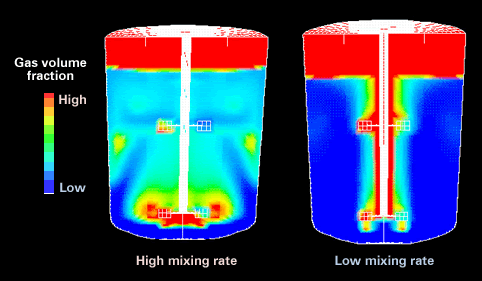
Computational Fluid Dynamics (CFD)


Computational fluid dynamics (CFD) is a branch of fluid mechanics that uses numerical methods and algorithms to solve and analyze problems that involve fluid flows. Computers are used to perform the calculations required to simulate the interaction of liquids and gases with surfaces defined by boundary conditions. With high-speed supercomputers, better solutions can be achieved. Ongoing research, however, yields software that improves the accuracy and speed of complex simulation scenarios such as transonic or turbulent flows. Initial validation of such software is performed using a wind tunnel with the final validation coming in flight tests.


The fundamental bases of almost all CFD problems are the Navier–Stokes equations, which define any single-phase fluid flow. These equations can be simplified by removing terms describing viscosity to yield the Euler equations. Further simplification, by removing terms describing vorticity yields the full potential equations.

Fluorescent Nanotubes Image Internal Organs


When conducting drug testing on laboratory mice, it's often useful to image the internal organs of the animals in detail. While there are accurate methods such as MRI or CT scans, the associated cost and complexity of these systems is not a very efficient solution. A cheaper and simpler technique involves injecting the animals with fluorescent dyes that are diffused into the blood stream and channeled to the internal organs. Read more on Discovery News.

Model Finds Optimal Fiber Optic Network Connections 10,000 Times More Quickly


 Designing fiber optic networks involves finding the most efficient way to connect phones and computers that are in different places, a costly and time-consuming process. Now researchers from North Carolina State University have developed a model that can find optimal connections 10,000 times more quickly, using less computing power to solve the problem. Read more on ScienceDaily.

Tech Turns Junk Plastics Into Diesel


Normally, potato chip bags, beer rings, gooey food wrappers and other plastics that cannot be recycled go directly to the dump. But improvements on an existing technology could divert billions of tons of "end-of-life" plastics from landfills and turn them into gas to run cars and trucks. Read more on Discovery News.

Integrate MATLAB Code Into InfoSphere Streams


This article by Dr. Buğra Gedik describes how to execute MATLAB functions from within InfoSphere Streams applications. MATLAB is a scientific computing language and platform. The strong support for matrix manipulation and large collection of mathematical modeling libraries make MATLAB a popular implementation choice for various analytic assets.

New Measurement Into Biological Polymer Networks


The development of a new measurement technology under a research project funded by the Air Force Office of Scientific Research and the National Science Foundation is probing the structure of composite and biological materials. Read more on Science Daily.

Caught in the Act: A Black Hole Scuttles a Star


A black hole 3.8 billion light-years from Earth is shown in this artist's representation tearing apart a star that drifted within its gravitational pull. This scenario is part of a new explanation for one of the brightest events ever recorded by astronomers. After consuming the star the black hole released a high-energy beam of gamma rays and x-rays, according to Joshua Bloom of the University of California, Berkeley, and his associates. Read more on SCIENTIFIC AMERICAN.

Curb Soot and Smog to Keep Earth Cool, Says UN


Sharply reducing emissions of soot and smog could play a critical role in preventing Earth from overheating, according to a UN report released on Tuesday.


Curbing these pollutants could also boost global food output and save millions of lives lost to heart and lung disease, said the report from the UN Environment Program (UNEP) and the World Meteorological Organization (WMO). Read more on Discovery News.

Two New Elements Join Periodic Table

Two new elements are being added to the periodic table after they were discovered through a collaboration between U.S. and Russian scientists, a top U.S. chemistry expert said Friday.


The elements are the first to be added since copernicium in 2009. They have not yet been named, but are known for now as 114 and 116. Read more on Discovery News. 

PID Controller Tuning

A proportional–integral–derivative controller (PID controller) is a generic control loop feedback mechanism widely used in industrial control systems. A PID controller calculates an "error" value as the difference between a measured process variable and a desired setpoint. The controller attempts to minimize the error by adjusting the process control inputs.


The PID controller algorithm involves three separate constant parameters, and is accordingly sometimes called three-term control: the proportional, the integral and derivative values, denoted P, I, and D. Heuristically, these values can be interpreted in terms of time: P depends on the present error, I on the accumulation of past errors, and D is a prediction of future errors, based on current rate of change. A framework for the PID parameter optimization, with stability guarantees, is proposed in “A refinement procedure for PID controller tuning”, has been published in Computer & Chemical Engineering.